




News & Stories
2025
Stories
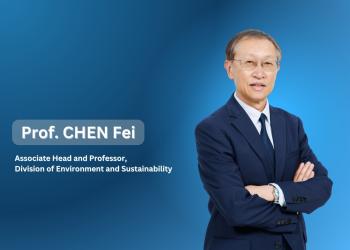
Beyond the Storm: A Climate Expert’s Vision for Actionable Climate Adaptation Solutions
Landslides, flash floods, and fallen trees—these are just some of the alarming sights accompanying the summer typhoon seasons in Hong Kong. Over the past decade, the city has witnessed a distressing surge in extreme rainfall, characterized by intensity levels that surpass the Black Rainstorm Warning Signal. This trend serves as a stark reminder of the growing impact of global warming on our daily lives and safety. The question resonates: how can we better prepare for nature’s fury in the future?
News
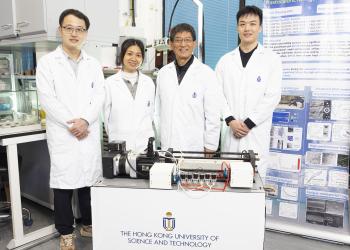
HKUST Develops World’s First Kilowatt-Scale Elastocaloric Green Cooling Device
Researchers at the Hong Kong University of Science and Technology (HKUST) have developed the world’s first kilowatt-scale elastocaloric cooling device. The device can stabilize indoor temperatures at a comfortable 21-22°C in just 15 minutes, even when outdoor temperatures reach between 30-31°C, marking a significant breakthrough toward the commercial application of elastocaloric solid-state cooling technology. The research findings have been published in the leading international science journal Nature, offering a promising solution to combat climate change and accelerate low-carbon transformation of the global cooling industry.
2024
News
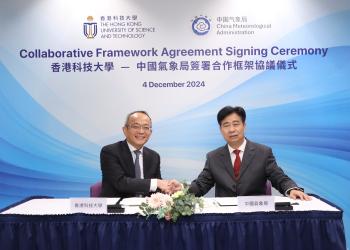
HKUST and CMA Form Strategic Partnership to Advance Meteorological Research and Global Climate Resilience
The Hong Kong University of Science and Technology (HKUST) and the China Meteorological Administration (CMA) have signed a collaborative framework agreement to drive innovation in meteorological science and education. By leveraging the complementary strengths of CMA and HKUST, the collaboration aims to enhance early warning systems, strengthen disaster preparedness, and build climate-resilient communities, underscoring the shared commitment of both institutions to tackle global climate challenges and support the initiatives of the World Meteorological Organization (WMO).
2022

News
HKUST Develops World’s Most Durable Hydrogen Fuel Cell
Researchers at The Hong Kong University of Science and Technology (HKUST) have developed a new hydrogen fuel cell which is not only the world’s most durable1 to date, but is also more cost-effective, paving way for a wider application of green energy in the pursuit of a carbon neutral world.Hydrogen fuel cell is a promising clean energy option as it generates power by converting hydrogen and oxygen into electricity, with zero emission of carbon dioxide, particulate matters and other air pollutants that may cause smog and other health problems. Despite its environmental benefits and years of development, hydrogen fuel cell was still not widely commercialized. That is because its power generation depends heavily on an electrocatalyst - which is largely made up of the expensive and rare metal platinum.
2019
News
HKUST Researchers Discover New Virus Traits That May Help Fight Global Warming and Develop Anti-virus Drug
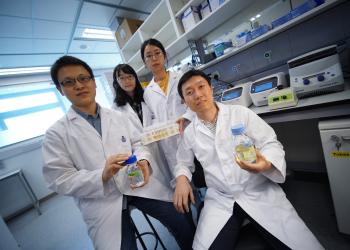
Oxygen levels in the ocean have depleted over the past few decades1 due to global warming and emissions of greenhouse gas, causing pollution and disrupting our ecosystem. In efforts to curb the trend, researchers from the Hong Kong University of Science and Technology (HKUST) discovered a mechanism that may eventually help an eco-friendly aquatic bacterium clean up more carbon dioxide in the ocean and produce more marine oxygen. Like trees on land, cyanobacteria, or what commonly known as blue-green algae, perform photosynthesis in the ocean. They provide oxygen for marine life and absorb over 20% of the world’s total carbon emission. However, natural predation and virus infection kill nearly half of the world’s cyanobacteria on a daily basis. A virus called cyanophage alone, wipes out one fifth of the total cyanobacterial population every day.
2011

News
HKUST Builds Hong Kong's First Multi-purpose Eco-Park for Teaching and Research
The Hong Kong University of Science and Technology opened its multi-purpose Eco-Park, the first of its kind in Hong Kong, today (8 September) to promote teaching and academic research on sustainability from a wider perspective.
News
HKUST Launches First Air Quality Research Supersite for Real-time Characterization
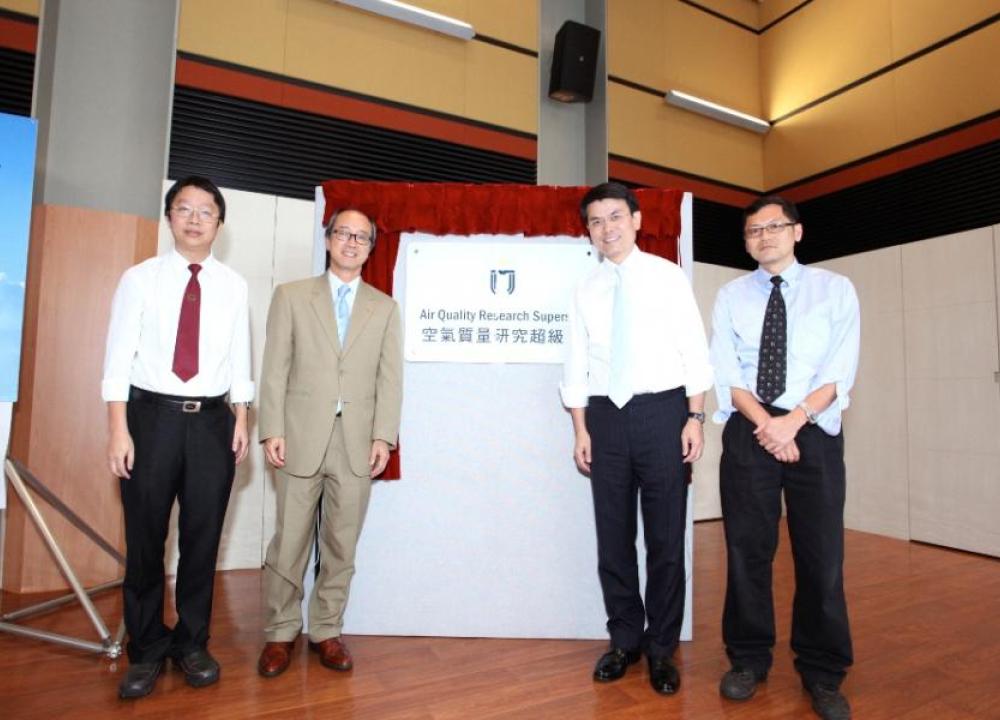
The Hong Kong University of Science and Technology (HKUST) launches the first Air Quality Research Supersite to enhance air quality research and to tackle air pollution problems in Hong Kong and the Pearl River Delta. With a HK$9 million Special Equipment Grant from the University Grants Committee and a HK$6 million grant from the Environmental Conservation Fund, the Supersite enables real-time characterization of ambient particulate matter (PM) in the air to strengthen understanding of the nature and sources of fine particles.