





News & Stories
2014
News
How Alcohol Fuel Cells Can Energize Our Future
As communities around the world are increasingly becoming aware of the importance of green and sustainable energy sources, fuel cells that convert chemical energy of hydrogen, natural gas, and alcohols directly to electricity have become a hot research topic. Current energy technologies that use fossil fuels, such as diesel, coal and oil, face many challenges including low efficiency, limited supply, air pollution, and climate change. Yet, to date, renewable energy still accounts for less than 3% of all electricity produced worldwide.
Power density record
Prof Zhao, Director of the HKUST Energy Institute, and his researchers have become global pioneers in raising the performance of Direct Alcohol Fuel Cells (DAFC). Among other achievements, his team holds the internationally acknowledged world record for the power density of direct ethanol fuel cells.
2013
News
HKUST Physicists Derive Optimal Routes for Transportation, Communication and Logistics Networks
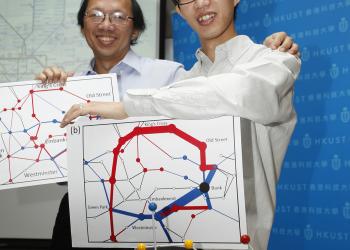
Dr Chi-ho Yeung and Prof Michael Wong from the Department of Physics at the Hong Kong University of Science and Technology (HKUST) in collaboration with Prof David Saad from Aston University in the UK have applied polymer physics to derive a novel approach for coordinating optimal routes for individual passengers. Their simulations using data from the London underground network show that the new method reduces crowding experienced by passengers by 24%, while journeys take only 5% longer on average. The findings have been published in the Proceedings of the National Academy of Sciences (PNAS) of the USA.
News
Intelligent Lighting (iLight) Systems using LED on Silicon (LEDoS) Technology
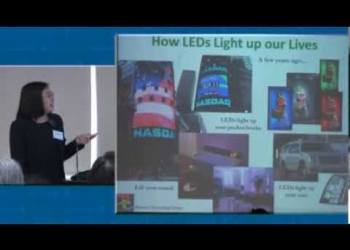
Prof Kei-May Lau and her team have developed an advanced LED technology which can significantly improve micro-display in mobile electronics, intelligent traffic systems, portable micro-projectors, etc. (From the “HKUST Science-for-Lunch” talk series)
News
Innovative Green Wastewater Treatment Technology
Prof Guanghao Chen invented an innovative green wastewater treatment technology known as SANI Process (殺泥技術). The technology successfully minimizes the adverse environmental impact of sewage treatment plant with reduced cost and space requirement. (From the “HKUST Science-for-Lunch” talk series)
News
New Nano Materials for Industry Applications
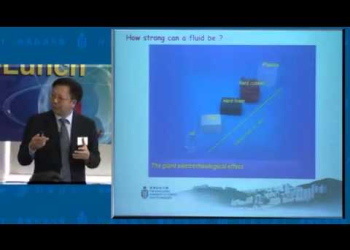
Prof Weijia Wen introduced some innovative applications of nanotechnology, including the "ER fluid" for clutches, electronic valve and damper, a "smart gel" for windows to help save energy, and a "smart drug" which can target tumor. (From the "HKUST Science-for-Lunch" talk series)
News
HKUST Unravels Molecular Mechanism Behind Autism and Neurodevelopmental Disorders
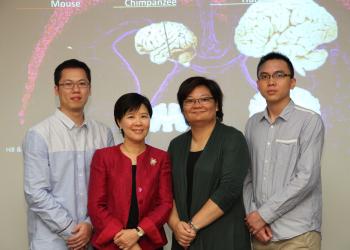
The Hong Kong University of Science and Technology (HKUST) has achieved another milestone in molecular neuroscience research. Prof Nancy Ip, Dean of Science, Director of the State Key Laboratory of Molecular Neuroscience and The Morningside Professor of Life Science at HKUST, and her research team have discovered a novel mechanism that controls brain cell production and cortical expansion. The study has significantly contributed to our understanding of the evolution of the brain and the molecular basis of neurodevelopmental disorders such as autism, with far-reaching implications for biomedicine. These groundbreaking discoveries have been published in Neuron, a prestigious journal in neuroscience.